Accessible Mobility Solutions: Where It All Started
Where It All Started — Our Journey
The idea began from my own experience and a clear gap I saw: there were no accessible pushchairs designed specifically for visually impaired parents. I knew firsthand how challenging it was to get out, navigate safely, and feel confident when obstacles, controls, or directions are not visible. There was nothing on the market that truly understood or met the needs of visually impaired support — so I set out to change that.
In the 2017–2018 academic year, under my former company, Eyes for Success, I partnered with engineering and design students at Imperial College London to turn this vision into a reality. Together, we conducted research, tested prototypes, and developed the very first working concept — built entirely around what visually impaired parents truly need: safety, independence, and the ability to navigate without assistance.
We did not develop an accessible pushchair from scratch. Instead, we took a standard, already manufactured model and integrated every necessary feature and adaptation to the exterior — this approach allowed us to test quickly, learn efficiently, and validate exactly what worked. We added:
- Tactile markers and guides — allowing users to feel exactly where handles, brakes, and essential parts are, requiring no sight.
- Obstacle-sensing technology — designed to detect objects in your path and alert you before coming too close.
- Clear labels and markers — enabling others to understand it was designed for accessibility.
Here I am with the students demonstrating how the system senses obstacles, showing exactly how it works to keep users safe and independent. https://youtu.be/4Hl_4OxprQQ?si=aZU5zOfc7U27JT72
This early prototype was purely experimental — never intended for sale, but rather to test, learn, and prove the concept. However, it provided us with everything we needed: evidence that this was possible, clear data on the most important features, and the foundation for all our current work.
Now, as Quacy’s Smart Mobility, we continue that mission — still fully engaged in research and development, refining every detail, and working towards a purpose-built, fully accessible mobility solution that will finally grant visually impaired parents the freedom, safety, and confidence they deserve.
This is not just a product — it originated from a genuine need, evolved through collaboration, and is grounded in real experience. This is where it all began.
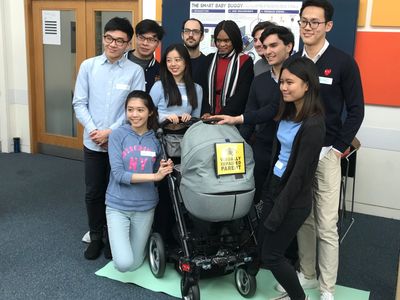
Founder of QUACY’S with Imperial College students, 2017–2018.